
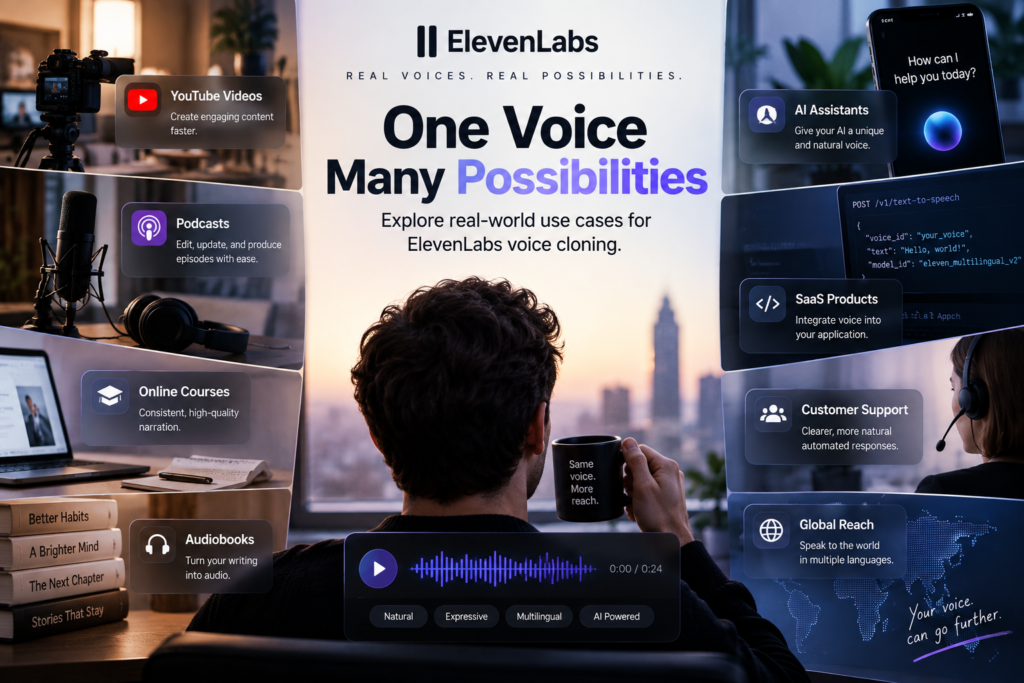
Voice Cloning for Audiobooks
Audiobooks are one of the most interesting applications for AI voice cloning because they require a large amount of narration.
A traditional audiobook production can involve recording sessions that last for many hours. The narrator has to maintain a consistent tone, pronunciation, and energy throughout the entire book. If a mistake is discovered later, recording the replacement sentence can also require careful editing to make it sound consistent with the surrounding audio.
Voice cloning changes the production process.
Once a suitable voice has been created, written chapters can be converted into narration without recording every paragraph manually. This can make production considerably faster, particularly for independent authors and publishers working with large amounts of content.
However, audiobook narration also exposes the limitations of AI voices more clearly than short-form content.
A five-minute YouTube video can hide occasional imperfections. Several hours of narration cannot.
For long-form audio, you should pay particular attention to:
- pronunciation of names and unusual words;
- consistency between chapters;
- pauses between sentences;
- emotional delivery;
- dialogue between characters;
- pacing during long passages;
- changes in tone between different sections.
For this reason, AI-generated audiobook narration should still be reviewed carefully before publication.
The technology can reduce production work, but quality control remains essential.
You may also like: https://aiworkflowtips.com/elevenlabs-voice-cloning-explained-2026-part-1/
Voice Cloning for AI Assistants
Voice cloning becomes even more interesting when combined with conversational AI.
Imagine an AI assistant that doesn’t simply display text on a screen but speaks to the user using a distinctive voice.
The application could receive a user’s question, generate a response using an AI language model, and then send that response to a voice-generation system.
The result is a conversational experience that feels much more natural than a traditional text chatbot.
A typical workflow might look like this:
User → AI assistant → Text response → ElevenLabs → Generated speech → User
This architecture can be used for many different types of applications.
For example:
- Personal assistants can provide spoken reminders, summaries, and answers.
- Educational applications can explain lessons using a consistent instructor voice.
- Language-learning platforms can provide spoken exercises and conversations.
- Interactive characters can respond to users using a specific personality and voice.
- Accessibility applications can convert information into natural spoken language.
The voice becomes more than an audio feature. It becomes part of the product’s identity.
You may also like: https://aiworkflowtips.com/how-to-clone-your-voice-with-elevenlabs/
Voice Cloning for SaaS Products
For SaaS companies, voice generation can become a product feature rather than simply a content-production tool.
Consider a writing application that allows users to turn articles into audio.
The application could automatically:
- receive an article;
- process the text;
- allow the user to choose a voice;
- generate the narration;
- return an audio file;
- store the result in the user’s account.
The user never needs to open ElevenLabs directly.
This is where an API becomes particularly valuable.
Instead of asking customers to manually generate audio, the developer integrates voice generation directly into the product.
This creates opportunities for applications such as:
- article-to-audio platforms;
- AI presentation tools;
- video creation software;
- language-learning applications;
- accessibility products;
- personalized learning platforms.
The important distinction is that the API allows voice generation to become part of a larger automated system.
Voice Cloning for Customer Support
Customer support is another potential application, although it requires more careful implementation.
A company could use AI-generated speech to provide automated responses, announcements, instructions, or other voice-based information.
For example, an automated system could explain:
“Your order has been shipped and is expected to arrive tomorrow.”
Instead of using a traditional robotic voice, the company could use a more natural AI-generated voice.
This can improve the perceived quality of automated interactions.
However, customer support is also an area where transparency matters. Users should understand when they are interacting with an automated system, particularly when the system is designed to sound like a specific real person.
The technology should improve the experience rather than deliberately mislead the user.
Voice Cloning vs. Traditional Voice Recording
The biggest question for many creators is whether voice cloning actually replaces traditional recording.
The answer is more complicated than simply choosing one or the other.
Both approaches have advantages.
| Factor | Voice Cloning | Traditional Recording |
|---|---|---|
| Production speed | Very fast | Slower |
| Re-recording corrections | Easy | Requires another recording |
| Consistency | High when properly configured | Depends on recording conditions |
| Emotional nuance | Improving rapidly | Human performance remains highly flexible |
| Large-scale production | Excellent | Expensive and time-consuming |
| Initial setup | Requires suitable voice samples | Requires recording setup |
| Human authenticity | Synthetic | Fully human |
| Multilingual production | Highly scalable | Requires additional recording |
| Creative direction | Requires prompting/editing | Direct performer control |
This table highlights an important point.
Voice cloning isn’t necessarily a replacement for professional voice actors.
For some projects, a human performer remains the better choice.
A commercial advertisement that depends on a highly emotional performance, for example, may benefit from a professional actor who can respond to a director in real time.
On the other hand, generating hundreds of educational lessons or updating thousands of pieces of spoken content is a very different problem.
For those workflows, automation can be considerably more practical.
When Should You Use Voice Cloning?
The best way to decide is to look at the characteristics of your project.
Voice cloning makes the most sense when you need repeatable speech at scale.
Consider using it when:
- You create content frequently.
If you’re publishing dozens of videos, lessons, or audio files, recording every piece manually can become a significant bottleneck. - You need consistent narration.
A recognizable voice can be maintained across a large content library. - You frequently update your content.
AI-generated narration makes replacing individual sections easier than organizing new recording sessions. - You need multiple language versions.
AI-generated speech can make localization more practical for creators and businesses. - You are building a software product.
An API allows voice generation to become part of your application’s workflow.
When Should You Stick With a Human Voice?
AI voice cloning is not automatically the best option.
There are situations where traditional recording makes more sense.
A human voice may be preferable when:
- the performance depends heavily on spontaneous emotion;
- the project is based on a personal connection with the audience;
- the speaker needs to interact with a director during recording;
- the voice is central to a live performance;
- authenticity is more important than production speed.
For example, a personal YouTube channel built around the creator’s personality may actually benefit from real recordings.
The audience isn’t necessarily looking for perfect audio.
They may be watching because they want to hear the creator.
That distinction is important when deciding whether AI voice cloning is appropriate.
Is ElevenLabs Voice Cloning Safe?
Voice cloning creates obvious benefits, but it also creates risks.
The ability to reproduce someone’s voice means that consent and responsible use are extremely important.
The simplest rule is also the most important:
Only clone a voice when you have the appropriate rights or permission to do so.
You should not assume that publicly available audio automatically gives you permission to clone the speaker’s voice.
A voice may be associated with a person’s identity, brand, professional work, or other rights. The legal situation can also vary depending on the country and the intended use.
Businesses should therefore treat voice cloning as both a technical and legal issue.
Before using a cloned voice commercially, consider:
- Who owns or controls the voice?
- Do you have permission to create the clone?
- Where will the generated content be published?
- Will the audience know that the voice is AI-generated?
- Could the generated speech create confusion about who actually said something?
These questions become particularly important when a recognizable person’s voice is involved.
How to Make an AI Voice Sound More Natural
A good voice model is only part of the equation.
The script itself has a major influence on the final result.
Written language and spoken language are not identical.
A sentence can look perfectly acceptable on a screen but sound awkward when spoken aloud.
For natural-sounding narration, try to:
- keep sentences reasonably short;
- use punctuation to create natural pauses;
- avoid unnecessary formal language;
- spell out unusual abbreviations when appropriate;
- check names and technical terminology;
- listen to the generated audio before publishing.
For YouTube content, it can also help to write the script specifically for narration rather than adapting an article word-for-word.
A viewer should feel as though someone is talking to them—not as though a webpage is being read aloud.
ElevenLabs Voice Cloning for YouTube: A Practical Workflow
For creators building a YouTube channel, a simple production system can look like this:
1. Write the script
Start with the actual story, explanation, or educational content.
Do not begin by generating the voice. The voice is only as useful as the script it is reading.
2. Edit the script for speech
Read the script aloud.
If you run out of breath halfway through a sentence, the sentence is probably too long.
If something sounds unnatural when spoken, rewrite it before generating the final narration.
3. Generate the voiceover
Select your approved voice and generate the narration.
4. Listen to the entire recording
Don’t only check the first thirty seconds.
Listen for incorrect pronunciation, unnatural pauses, changes in tone, and sentences that don’t sound right.
5. Fix problem sections
Regenerate individual sections rather than automatically accepting the first result.
6. Add the voiceover to your video
Combine the narration with your visuals, music, sound effects, and captions.
7. Review the finished video
The final review should happen with everything together.
A voice can sound excellent by itself but feel too slow or too fast once combined with the visuals.
Common Mistakes to Avoid
The biggest mistake is treating voice cloning as a one-click solution.
It isn’t.
A successful workflow requires several decisions before and after generation.
Here are the problems worth watching for:
- Poor source recordings can produce an inconsistent or less convincing clone.
- Weak scripts make even a realistic voice sound unnatural.
- Incorrect pronunciation can become especially noticeable with names, brands, and technical terminology.
- No quality control allows mistakes to reach the final video.
- Overuse of emotional effects can make speech sound artificial rather than natural.
- Ignoring consent and licensing can create serious legal and reputational problems.
- Assuming AI replaces every human performance leads to inappropriate use of the technology.
The goal should not be to remove humans from the workflow completely.
The goal is to automate the parts where automation actually provides an advantage.
Who Should Use ElevenLabs Voice Cloning?
Voice cloning is particularly interesting for people who produce large amounts of spoken content.
The strongest use cases include:
| User | Why Voice Cloning Makes Sense |
|---|---|
| YouTube Creator | Faster recurring voiceovers |
| Podcaster | Corrections and additional narration |
| Course Creator | Consistent lesson narration |
| Author | Audiobook production |
| SaaS Founder | Voice-powered product features |
| Developer | AI applications and assistants |
| Agency | Scalable client content |
| Business | Consistent branded audio |
For someone who produces one short video every few months, voice cloning may not provide enough value to justify the setup.
For someone producing content every week, the economics and time savings can be much more compelling.
Final Verdict: Is ElevenLabs Voice Cloning Worth It?
ElevenLabs Voice Cloning is most useful when you have a repeatable reason to generate speech.
That’s the key point.
If you’re simply curious about hearing an AI imitate your voice, the technology is certainly interesting.
But the more valuable applications are practical.
You can use a cloned voice to create recurring YouTube narration, update online courses, produce audio versions of written content, localize content, or integrate speech into an application.
The technology also changes the economics of voice production.
Instead of treating every new piece of narration as a separate recording project, creators can turn voice generation into part of an automated content workflow.
At the same time, there are limits.
AI-generated speech isn’t automatically better than a professional human performance. It still requires good source material, good writing, careful review, and responsible use.
So the answer is relatively simple:
Use voice cloning when consistency, scalability, and production speed matter. Use a human voice when performance, spontaneity, and personal authenticity are the priority.
For many creators and developers, the most effective solution may actually be a combination of both.
Frequently Asked Questions
What is ElevenLabs Voice Cloning?
ElevenLabs Voice Cloning allows users to create an AI-generated voice based on a voice sample. The resulting voice can then be used to generate new speech from written text.
Can I clone my own voice?
Yes. Voice cloning can be used to create an AI version of your own voice, provided you follow the platform’s requirements and applicable terms.
How much audio do I need to clone a voice?
The amount of audio required depends on the cloning method and the specific ElevenLabs workflow available to you. More importantly, the source material should be clean, consistent, and representative of the voice.
Can I use an AI voice clone for YouTube?
Yes. AI voice generation can be used as part of a YouTube production workflow. Creators commonly use synthetic narration for educational, explainer, documentary, and faceless content.
Can ElevenLabs clone a celebrity’s voice?
You should not assume that you can legally clone or commercially use a recognizable person’s voice simply because recordings of that person are publicly available. Appropriate authorization and the applicable platform terms and laws matter.
Is AI voice cloning better than a human voice?
Not universally. AI voice cloning is particularly useful for speed, consistency, and scale, while human performers remain highly valuable when a project depends on nuanced performance and authentic personal delivery.
Can I use a cloned voice in an app?
Yes, voice generation can be integrated into applications through appropriate ElevenLabs functionality and API access. This allows developers to make generated speech part of a larger software workflow.
Can I use voice cloning for audiobooks?
AI-generated narration can be useful for audiobook production, but long-form audio requires careful quality control. Pronunciation, pacing, consistency, and licensing should all be reviewed before publication.
Affiliate Disclosure
Some links in this article are affiliate links. If you choose to purchase a product or subscription through one of our links, we may receive a commission at no additional cost to you.
Our goal is to recommend tools based on their usefulness for creators, developers, and businesses rather than simply promoting products because they offer an affiliate program.
This concludes the three-part ElevenLabs Voice Cloning guide.