Building a website does not have to be a long-term project that generates income only through advertising or affiliate commissions. A website can also become a digital asset that is eventually sold to another owner.
This business model is often called website flipping. The basic idea is straightforward: create a website, develop its content and audience, establish monetization, and sell the finished project when it becomes attractive to potential buyers.
A website does not necessarily need to become a large business before it can be sold. However, there is an important distinction between selling a newly created website and selling an established online business. A site with a domain and several articles may have some value, but a site with consistent traffic, verified revenue, and documented processes is generally more attractive.
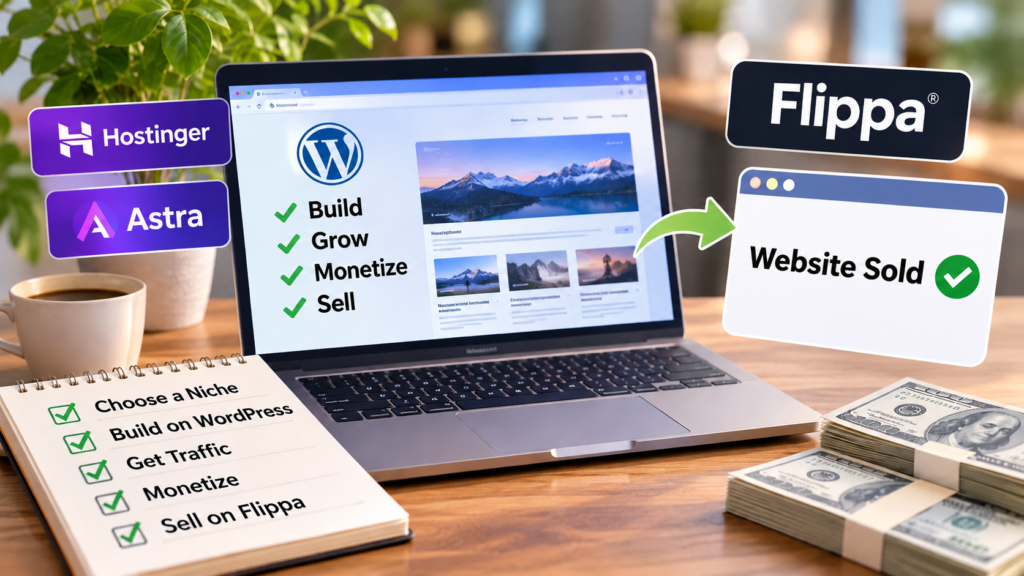
This guide explains how to build a WordPress website using Hostinger and Astra, develop it, apply for monetization programs, and prepare it for a potential sale on Flippa.
It is important to approach this as a business project rather than a guaranteed way to make money. A website may take months to gain visibility, monetization applications may be rejected, and finding a buyer is never guaranteed.
1. Choose a Website Niche Before Building
The first decision is the website’s topic. It affects the type of content required, potential traffic sources, monetization opportunities, and the audience that might eventually be interested in buying the site.
A niche should ideally meet three criteria:
- There is an identifiable audience. People actively search for information, products, services, or solutions related to the topic.
- There are monetization opportunities. Relevant affiliate programs, advertising, sponsorships, or digital products are available.
- The topic can support further development. It should be possible to publish useful content consistently without repeating the same ideas.
Broad topics such as technology, health, finance, and travel can be difficult for a new website because they involve strong competition. A narrower subject may provide a more realistic starting point.
For example, instead of creating a general technology blog, a website could focus on AI tools for video creators, WordPress tutorials for small businesses, or software comparisons for freelancers.
The goal is not simply to find a popular topic. It is to identify a niche where useful content can be created and where visitors may have a reason to click, subscribe, purchase, or return.
What types of websites are worth building in 2027?
The development of Google AI Overviews and AI Mode is changing how users interact with search results. Some informational searches may receive direct answers without requiring a visit to an external website. This can make websites based entirely on basic informational articles more vulnerable to changes in organic search traffic.
However, it would be inaccurate to assume that Google no longer sends traffic to informational websites. The impact varies by search query, topic, location, and search results layout. Practical websites that offer something beyond a basic answer may have additional ways to attract and retain visitors.
Potential directions include product comparison websites, online tools and calculators, niche directories, template libraries, and specialized websites that solve a specific problem.
2. Build a WordPress Website with Hostinger and Astra
Once the niche has been selected, the next step is creating the website itself.
WordPress is a practical option because it provides flexibility, a large ecosystem of plugins, and relatively straightforward content management. It can support a simple blog, a product review website, a directory, or a more complex online project.
A beginner does not need to develop a website from scratch. Hosting, WordPress, and a suitable theme are enough to create the initial structure.
Step 1. Choose a hosting provider
A website needs hosting: a service that stores its files and makes them accessible online.
Hostinger offers WordPress hosting plans and tools designed to simplify website setup. Depending on the selected plan and current availability, its features may include automated WordPress installation, website management tools, backups, and AI-assisted website creation or content-related features.
For a new project, it is worth comparing the available plans rather than automatically choosing the most expensive option. Consider renewal prices, storage, backup conditions, performance limits, and the number of websites supported.
Step 2. Register a domain name
A domain is the website’s address, such as example.com.
A good domain should be easy to remember, reasonably short, and relevant to the project’s subject. It is better to avoid names that are difficult to spell or too closely associated with a temporary trend.
The domain is also an asset that may be included in a future website sale. Ideally, it should be registered in an account that can be securely transferred or managed during a transaction.
Step 3. Install WordPress
Many hosting providers offer automatic WordPress installation. After selecting a domain and completing the hosting setup, WordPress can usually be installed through the hosting control panel.
Once installation is complete, the website dashboard is accessible through the WordPress admin area.
The initial configuration should include:
- Setting the website title and description.
- Choosing the correct language and time zone.
- Configuring readable URL structures.
- Checking the website’s visibility settings.
- Installing an SSL certificate and confirming that the site uses HTTPS.
- Removing unnecessary default content and plugins.
These basic settings help establish a clean foundation before publishing articles.
Step 4. Install the Astra theme
A WordPress theme determines the website’s appearance and much of its layout.
Astra is a lightweight WordPress theme that offers a range of starter templates and customization options. It can be used for blogs, business websites, affiliate projects, and other types of content websites.
Astra is particularly useful when the goal is to create a professional-looking website without hiring a developer or building every page manually.
The theme can be customized through WordPress settings and compatible page builders. Its available features depend on whether the free or paid version is used.
Step 5. Create the essential pages
Before publishing a large amount of content, the website should have a basic structure.
At a minimum, consider creating:
- Homepage: Introduces the website and directs visitors to its main sections.
- About: Explains the website’s purpose and the audience it serves.
- Contact: Provides a way to reach the website owner.
- Privacy Policy: Explains how visitor data is handled.
- Affiliate Disclosure: Clearly informs visitors when links may generate commissions.
- Terms and Conditions: Sets out the basic rules governing website use, where appropriate.
The exact legal requirements depend on the website’s audience, location, and business model. A generic template should not be treated as a substitute for checking applicable privacy and consumer-protection requirements.
3. Publish Useful Content and Build Search Visibility
After the technical setup, the main task is developing the website’s content.
Publishing a large number of articles quickly is not necessarily a good strategy. Buyers are unlikely to value a website simply because it contains hundreds of pages. They will be more interested in whether the content attracts an audience, meets a real need, and contributes to the site’s overall value.
A more useful approach is to build a structured content library around the chosen niche.
Create topic clusters
A topic cluster consists of one main article supported by several related articles.
For example, a website about AI tools for YouTube could include:
- A main guide to AI tools for YouTube.
- Reviews of individual AI video tools.
- Comparisons of competing platforms.
- Tutorials explaining specific workflows.
- Guides to AI voice generators.
- Articles about creating and editing videos.
Related articles should link to one another where the links genuinely help readers. This makes the site easier to navigate and helps search engines understand the relationship between its pages.
Focus on search intent
Before writing an article, identify what the reader actually wants to accomplish.
A person searching for a product review is likely comparing features, pricing, and alternatives. Someone searching for a tutorial needs clear instructions. A reader looking for a definition may need a concise explanation.
The content should match that intent rather than simply repeat the target keyword.
AI tools can assist with research, outlines, editing, and content production. However, publishing large quantities of generic AI-generated text without checking accuracy or adding useful information can create a weak website.
Each article should be reviewed for factual accuracy, usefulness, originality, and readability.
Connect Google Search Console and analytics
Google Search Console helps monitor how a website performs in Google Search. It can show:
- Which search queries generate impressions and clicks.
- Which pages appear in search results.
- Whether pages are indexed.
- Whether technical or indexing issues have been detected.
An analytics tool can provide additional information about visitors, traffic sources, engagement, and conversions.
These records are important not only for improving the website but also for a future sale. Buyers may want to verify traffic figures rather than rely on screenshots or unsupported claims.
One important distinction: indexing does not mean that a website is receiving meaningful traffic. A page can be indexed and still receive very few impressions or clicks.
4. Apply for Google AdSense and Affiliate Programs
Once the website has a reasonable amount of useful content and a functioning structure, monetization can be considered.
Two common options are display advertising and affiliate marketing.
It is not necessary to wait until the website is one year old to apply for monetization programs. Each program has its own eligibility requirements, and approval depends on the website and the provider’s policies.
Google AdSense
Google AdSense allows website owners to display advertisements and potentially earn revenue when visitors interact with them.
Before applying, check that the website has:
- Original and useful content.
- Clear navigation and a functional layout.
- Required policy and privacy information.
- No prohibited content or policy violations.
- A reasonable user experience across desktop and mobile devices.
There is no universal article-count threshold that guarantees approval. Publishing more articles does not automatically make a website eligible.
If the application is rejected, the project does not have to be abandoned. The rejection reason should be reviewed, the relevant issues addressed, and a new application considered when the site is ready.
AdSense approval can make a website more attractive to some buyers, but it does not guarantee a higher sale price. Buyers will still examine actual revenue, traffic quality, and the stability of the business.
An important detail: an AdSense account itself is not transferred with the website. The buyer generally needs to apply for and use their own account. The website and its eligible assets can be sold, but the seller’s personal AdSense account should not be treated as part of the transaction.
Affiliate marketing
Affiliate marketing allows a website to earn commissions when visitors purchase products or services through special tracking links.
This model can be particularly relevant to websites focused on product reviews, software tutorials, comparisons, and recommendations.
For example, a website about WordPress could promote hosting providers, themes, plugins, and website-building tools. A website about video production could include affiliate links to editing software, AI voice generators, and other creator tools.
Before joining a program, check:
- Whether the program accepts new websites.
- Which countries and traffic sources are eligible.
- Commission rates and payment conditions.
- Cookie duration and attribution rules.
- Restrictions on promotional methods.
- Whether the affiliate agreement can continue after a website sale.
Affiliate links should be relevant to the content and clearly disclosed. A website filled with promotional links but offering little independent value may be less appealing to both readers and potential buyers.
Why multiple revenue streams matter
A website that depends on a single monetization source may be more vulnerable to changes in platform policies, commission rates, or advertising demand.
Where appropriate, several revenue sources can be developed:
- Display advertising.
- Affiliate commissions.
- Sponsored content.
- Digital products.
- Paid subscriptions or memberships.
- Lead generation.
Not every website needs all of these models. The monetization strategy should fit the audience and the site’s subject.
5. Develop the Website Over the Following Months
After the website is launched and monetization applications have been submitted, the next stage is consistent development.
A period of around 12 months can be a useful planning horizon because it provides time to collect traffic and financial data. However, one year is not a mandatory waiting period, and it does not guarantee that the website will become valuable.
The focus should be on measurable progress.
Monitor traffic and content performance
Review Search Console and analytics regularly. Identify pages that attract visitors, queries that generate impressions, and articles that need improvement.
If an article receives impressions but few clicks, its title and search intent may need further examination. If a page receives traffic but generates no conversions, the content, offer, or user journey may need improvement.
Avoid making decisions based on a single unusually good or bad week. Longer-term trends are more useful.
Improve the website’s user experience
A website should be easy to use on both desktop and mobile devices.
Check page loading performance, navigation, broken links, image sizes, and the overall layout. Remove unnecessary plugins and features that add complexity without providing meaningful value.
A potential buyer will be assessing the website as an asset that needs to be maintained after the transaction. A clean, well-organized WordPress installation is easier to evaluate and hand over.
Keep records from the beginning
Good documentation can make a significant difference when preparing a website for sale.
Keep records of:
- Monthly traffic and traffic sources.
- Advertising and affiliate revenue.
- Hosting, software, and other operating expenses.
- Content production costs.
- Affiliate agreements and relevant restrictions.
- Domain registration and hosting details.
- Major changes to the website.
Financial records should distinguish revenue from profit. A website generating $500 per month but spending $450 on content and services has a very different financial profile from one generating the same revenue with minimal expenses.
6. Prepare the Website for Sale on Flippa
When the website has developed an audience, revenue, or another demonstrable source of value, it may be suitable for sale.
Flippa is an online marketplace for buying and selling websites, online businesses, domains, and other digital assets.
It can be used to list different types of projects, from established revenue-generating websites to newer websites without verified revenue. However, the listing rules and maximum asking prices depend on the asset category.
Flippa: [Insert the Flippa affiliate link here]
Does a website need to be one year old before it can be sold?
No. A website does not automatically need to operate for 12 months before it can be listed.
Newly created websites and non-revenue-generating assets may be listed under Flippa’s rules for starter or non-revenue-generating assets. These listings have different pricing limits from established businesses.
For a revenue-generating website, a longer and more consistent performance history is generally more useful. It gives buyers a better basis for evaluating the site’s financial performance and risks.
The practical distinction is simple:
- A new website may be sellable, but its value is usually based more on its domain, content, design, and development potential.
- A website with verified traffic and revenue can be evaluated using its operating performance.
- A website with stable earnings, diversified traffic, and documented processes may be more attractive to buyers seeking an established business.
Flippa’s listing requirements and pricing rules can change, so they should be checked before preparing a listing.
What information should be included in a listing?
A clear listing should explain what the buyer is acquiring and provide evidence for important claims.
Typical information includes:
- Website URL and niche.
- Website age and history.
- Monthly traffic and traffic sources.
- Monthly revenue and expenses.
- Monetization methods.
- Main content categories.
- Domain and hosting details.
- Included digital assets.
- Any operational requirements or ongoing costs.
Traffic and revenue figures should be supported by reliable records. If the site receives traffic from Google, social media, email, or referral links, these sources should be described separately.
Buyers may also ask about content ownership, copyright permissions, affiliate agreements, and whether the site depends on the current owner’s personal involvement.
How much can a website sell for?
There is no fixed price for a website based on its age or number of articles.
For an established website, buyers often consider its profit and apply a valuation multiple. The multiple depends on the niche, growth, traffic sources, revenue stability, operational complexity, and perceived risk.
Flippa’s published H1 2026 data reported an average multiple of 2.32 times annual profit for content websites sold during that period, while the top quartile achieved 4.68 times annual profit. These figures are historical marketplace data, not a guaranteed valuation formula for an individual website.
For example, if a website generates $500 in monthly profit, its annual profit is $6,000.
Using the above multiples purely as an illustration:
| Valuation multiple | Indicative value |
|---|---|
| 2.32x annual profit | $13,920 |
| 4.68x annual profit | $28,080 |
This is not a price prediction. A small website with unstable traffic or declining revenue may receive a much lower offer. A site with diversified traffic, repeat visitors, reliable earnings, and low operating costs may be valued more favourably.
For a new website without verified revenue, this profit-based approach may not be applicable. Its asking price will be subject to the relevant marketplace rules and buyer demand.
A useful starting point is Flippa’s website valuation tool.
What makes a website more attractive to buyers?
Several factors can influence buyer interest:
Stable traffic. A website with consistent traffic is generally easier to evaluate than one that experienced a short-lived spike.
Verified revenue. Buyers want evidence of actual earnings, not estimates based on hypothetical traffic or potential affiliate commissions.
Diversified traffic sources. Heavy dependence on one search engine or one social platform creates risk. Email subscribers, direct traffic, referrals, and other sources may improve resilience.
Multiple monetization methods. A website with several relevant revenue streams may be less exposed to changes in a single affiliate program or advertising platform.
Quality content. Original, useful content with clear ownership and proper documentation is more valuable than a large collection of low-quality pages.
Simple operations. A website that can be maintained without constant involvement from its current owner is easier to transfer to a new operator.
7. How to Transfer a Website Safely
Once a buyer has been found and the transaction agreed, the assets need to be transferred.
A typical website sale may include:
- The domain name.
- WordPress website files and database.
- Content, images, and other media that can legally be transferred.
- Relevant documentation.
- Email lists, if legally transferable and properly disclosed.
- Social media accounts or other assets explicitly included in the agreement.
- Relevant business agreements, subject to their transfer conditions.
Not every asset can automatically be transferred. Hosting accounts, affiliate relationships, advertising accounts, licenses, and third-party services may have separate rules.
The transfer process should be agreed in advance. Payment should be secured through an appropriate escrow or marketplace-supported payment process before control of the domain and website is handed over.
The buyer should also understand which services need to be registered independently. For example, the new owner will generally need their own AdSense account.
A written agreement should specify the assets included in the sale, the payment terms, the transfer process, and any responsibilities that remain with either party.
8. A Practical 12-Month Website Development Plan
The following schedule is an example, not a guaranteed formula. The actual timeline will depend on the niche, content production capacity, competition, and website performance.
| Period | Main tasks |
|---|---|
| Month 1 | Select a niche, register a domain, purchase hosting, install WordPress and Astra |
| Months 2–3 | Create essential pages, publish initial content, configure Search Console and analytics |
| Months 4–6 | Expand topic clusters, improve existing articles, evaluate traffic and user behaviour |
| Months 6–9 | Apply to suitable monetization programs, test relevant affiliate offers, improve conversions |
| Months 9–12 | Review financial performance, document processes, assess valuation and prepare sale materials |
The schedule should remain flexible. If the website has not attracted meaningful traffic after several months, publishing more articles without investigating the reasons may not be the best solution.
It may be necessary to reconsider the niche, content quality, search intent, technical setup, or monetization model.
Similarly, if a website begins generating consistent revenue earlier than expected, there may be no reason to wait until the end of the year before exploring a sale.
9. Common Mistakes When Building Websites for Resale
Website flipping can look simple from the outside, but several mistakes can reduce the value of a project.
Publishing large quantities of generic AI content
AI can help with research and writing, but quantity alone does not create a valuable website. Generic articles that repeat information already available elsewhere may struggle to attract visitors or retain readers.
A stronger approach is to use AI as an assistant while adding original analysis, examples, comparisons, testing, and practical value.
Choosing a niche only because it has high commissions
High affiliate commissions do not guarantee sales. A niche may have attractive commission rates but intense competition, low buyer demand, or an audience that rarely converts.
The business model should be evaluated before the website is built.
Relying entirely on Google traffic
Search traffic can be valuable, but it is exposed to algorithm updates and changes in search results, including AI-generated answers.
Where possible, build additional sources of audience access, such as an email newsletter, relevant social media channels, partnerships, and referral traffic.
Ignoring expenses
Revenue is not the same as profit. Hosting, paid plugins, content production, software subscriptions, advertising, and outsourcing costs should all be recorded.
A website that generates revenue but has high operating costs may be less attractive to a buyer.
Assuming monetization approval guarantees a higher valuation
AdSense approval and affiliate partnerships can support a website’s business model, but they do not guarantee a premium sale price.
Buyers are more likely to focus on verified earnings, traffic quality, stability, and transferability than on the mere presence of monetization accounts.
Waiting exactly one year before considering a sale
A year can provide useful performance history, but it is not a universal requirement. Some new projects can be listed earlier, while other websites may need substantially more time to establish a reliable audience and revenue.
The decision should be based on the site’s actual performance and the marketplace’s current listing rules.
Conclusion
Building and selling websites can be a way to turn a digital project into a saleable asset. The process begins with choosing a suitable niche, setting up WordPress, publishing useful content, and developing reliable traffic and monetization.
Hostinger can simplify the hosting and setup process, while Astra provides a flexible design foundation. Google AdSense and affiliate programs may create revenue opportunities, but approval and earnings are never guaranteed.
After the website has developed measurable value, Flippa can provide a marketplace for reaching potential buyers. A successful sale, however, depends on more than the number of articles or the website’s age. Verified revenue, stable traffic, clear documentation, and an uncomplicated transfer process are all important.
The most realistic approach is to build the website as a useful online business first. If it attracts an audience and develops a sustainable business model, selling it can become a logical next step.
Frequently Asked Questions
Can a newly created website be sold?
Yes. New websites and non-revenue-generating assets may be listed on Flippa under the applicable marketplace rules. However, a website without traffic or revenue will generally be evaluated differently from an established business.
How long does it take to build a website that can be sold?
There is no fixed timeline. A period of 6–12 months can provide time to develop content and collect performance data, but some projects take longer. A website’s actual value depends on its audience, revenue, niche, and other assets.
Does a website need Google AdSense approval before it can be sold?
No. AdSense approval is not a universal requirement for selling a website. A site can use affiliate marketing, other monetization methods, or have no revenue at all. However, the lack of revenue may affect its valuation.
Can a Google AdSense account be included in a website sale?
The AdSense account itself should not be treated as a transferable asset. The buyer generally needs to apply for their own account. The website and its eligible assets can be sold separately.
Is WordPress a good platform for website flipping?
WordPress can be a practical choice because it is widely used, flexible, and supported by a large ecosystem of themes and plugins. It can support many types of websites, although the quality of the project matters more than the platform alone.
How much money can be made by selling a website?
There is no guaranteed amount. New websites without revenue may sell for relatively modest prices, while established businesses with verified earnings may be valued using profit-based multiples. The final price depends on buyer demand, financial performance, traffic quality, and marketplace conditions.
Affiliate Disclosure: This article contains affiliate links. If a purchase is made through some of these links, a commission may be earned at no additional cost to the buyer. Affiliate relationships do not determine the editorial conclusions or guarantee that a product or service is suitable for every reader.