
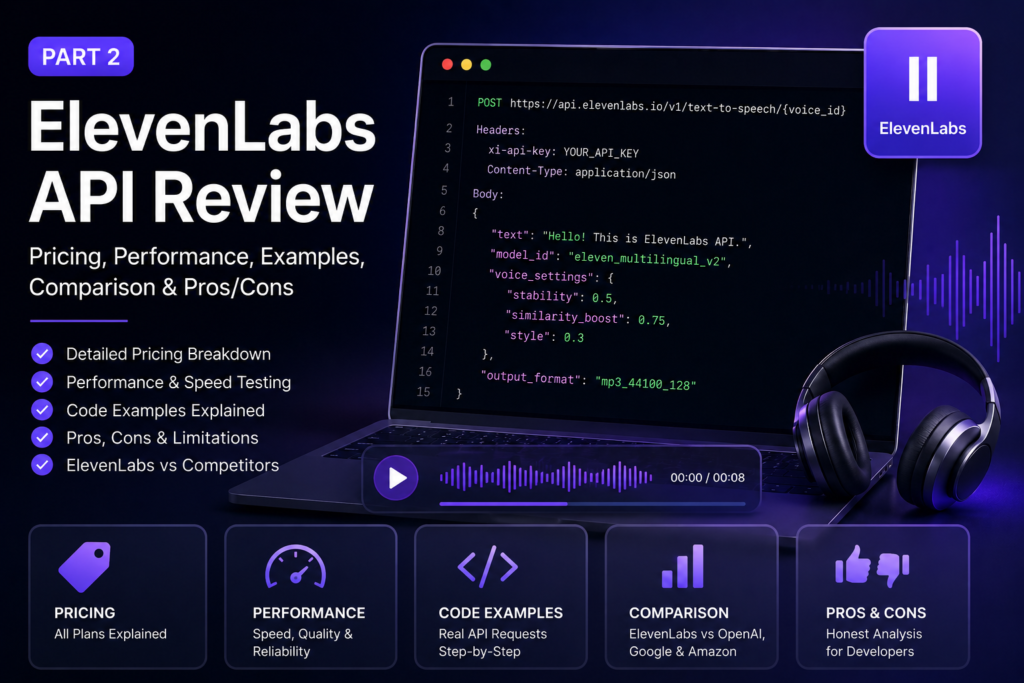
This is a continuation of the first part.
One of the first questions developers ask is whether the ElevenLabs API is worth the cost.
The answer depends on how you plan to use it.
If you’re generating a few voiceovers each month, the pricing is unlikely to be a major concern. However, if you’re building a SaaS platform, a large-scale content automation system, or a customer support solution that generates thousands of voice requests every day, API costs quickly become part of your business model.
Unlike traditional software subscriptions, API pricing is directly connected to usage. The more text you convert into speech, the more credits you consume. This makes it important to estimate your expected workload before choosing a plan.
Fortunately, ElevenLabs offers several pricing tiers that allow individuals, creators, and businesses to start small and scale as demand grows.
ElevenLabs API Pricing Overview
| Plan | Best For | API Access | Voice Cloning | Commercial Use |
|---|---|---|---|---|
| Free | Testing and learning | Limited | Basic | Limited |
| Starter | Individual creators | Yes | Yes | Yes |
| Creator | YouTube creators & freelancers | Yes | Advanced | Yes |
| Pro | Agencies & growing businesses | Yes | Advanced | Yes |
| Scale / Business | SaaS & enterprise | Full | Full | Yes |
While the Free plan is useful for testing the API and learning how it works, it isn’t designed for production projects. Most developers building commercial products eventually move to one of the paid plans because of higher usage limits and access to more advanced features.
For YouTube creators and small businesses, the Creator plan is often the best balance between price and functionality. It provides enough monthly capacity for regular content production while unlocking more advanced voice capabilities.
Larger companies typically choose Pro or Scale plans, especially when voice generation becomes a core part of their product rather than an occasional feature.
API Documentation Review
Even the most powerful API can become frustrating if the documentation is difficult to understand.
Fortunately, this is one area where ElevenLabs performs well.
The official documentation is clean, well organized, and easy to navigate. Instead of presenting hundreds of disconnected endpoints, it groups related functionality together and provides practical examples for most common tasks.
Developers will find documentation for:
- authentication
- voice management
- text-to-speech
- speech-to-speech
- streaming audio
- project management
- history endpoints
- webhooks
Perhaps more importantly, the documentation explains the required parameters clearly. Each endpoint includes example requests, response formats, and error messages, making it much easier to troubleshoot problems.
For developers who are new to REST APIs, there is still a learning curve, but compared to many AI platforms, ElevenLabs is considerably more approachable.
Getting Your API Key
Before making your first request, you’ll need an API key.
This key acts as your application’s identity and allows ElevenLabs to authenticate every request you send.
Getting started is straightforward:
- Create an ElevenLabs account.
- Open your account settings or developer dashboard.
- Generate a new API key.
- Store the key securely.
- Never expose it in client-side code or public repositories.
Many beginners accidentally publish their API keys on GitHub or embed them directly into frontend applications. This is a serious security mistake because anyone who obtains your key can generate requests using your account and consume your credits.
A better approach is to store the key as an environment variable or use a secure backend service to handle API requests.
Making Your First API Request
One of the reasons ElevenLabs has become popular among developers is that creating your first request doesn’t require much code.
A typical request includes:
- your API key
- the selected voice ID
- the text you want to convert
- voice settings
- output format
After the request is processed, the API returns an audio stream or downloadable audio file.
From there, you can:
- save it
- stream it
- send it directly to users
- attach it to videos
- integrate it into your application
For experienced developers, the entire integration process can take less than an hour.
Performance and Speed
Performance is often overlooked when comparing AI APIs.
Voice quality is important, but response time matters just as much—especially for real-time applications.
For example, if you’re generating voiceovers for YouTube, waiting a few extra seconds isn’t a major issue.
However, if you’re building a conversational AI assistant or customer support chatbot, even a short delay can make the interaction feel unnatural.
Based on current platform capabilities and developer feedback, ElevenLabs performs particularly well in three areas.
Natural Voice Quality
This is arguably the platform’s biggest strength.
Speech sounds smooth, expressive, and much less synthetic than older text-to-speech systems. Features such as realistic pauses, emotional delivery, and natural pacing make long-form listening far more comfortable.
This is one of the main reasons many creators choose ElevenLabs over traditional speech synthesis providers.
Response Time
Generation speed is generally fast, although exact performance depends on several factors, including text length, selected model, and server load.
For shorter requests, responses are typically returned within a few seconds. Longer scripts naturally take more time, but the overall experience remains responsive enough for most production workflows.
Applications that require near real-time interaction can also take advantage of streaming endpoints to reduce perceived latency.
Reliability
An API is only useful if it’s dependable.
Developers need predictable performance, stable endpoints, and consistent responses, especially when voice generation is integrated into automated workflows.
ElevenLabs has built a reputation for reliability, although occasional service interruptions or maintenance windows can occur—as with any cloud platform.
For business-critical applications, it is still good practice to implement retries, error handling, and fallback mechanisms rather than assuming every request will succeed on the first attempt.
Advantages of the ElevenLabs API
No API is perfect, but ElevenLabs has several strengths that explain why it has become so widely adopted.
Exceptional Voice Quality
The most obvious advantage is speech quality.
Rather than producing flat, mechanical narration, the platform generates voices that include subtle emotional variation and more natural rhythm.
For content creators, this often means less editing and fewer attempts to achieve a convincing result.
Developer-Friendly Integration
The API follows modern REST principles, making it familiar to most developers.
Clear documentation, straightforward authentication, and predictable endpoints reduce the amount of time needed to build an integration.
For small teams and independent developers, this ease of implementation can significantly reduce development costs.
Scalable Infrastructure
Projects often begin with a few hundred requests but can quickly grow to thousands or even millions.
The API is designed to scale alongside your application, allowing businesses to expand without completely redesigning their voice infrastructure.
This makes ElevenLabs suitable not only for hobby projects but also for commercial products with growing user bases.
Extensive Voice Library
Having access to a diverse collection of voices eliminates the need to create custom voice models for every project.
Developers can experiment with different styles, accents, and personalities during prototyping before deciding whether voice cloning is necessary.
This flexibility speeds up development and reduces production costs.