
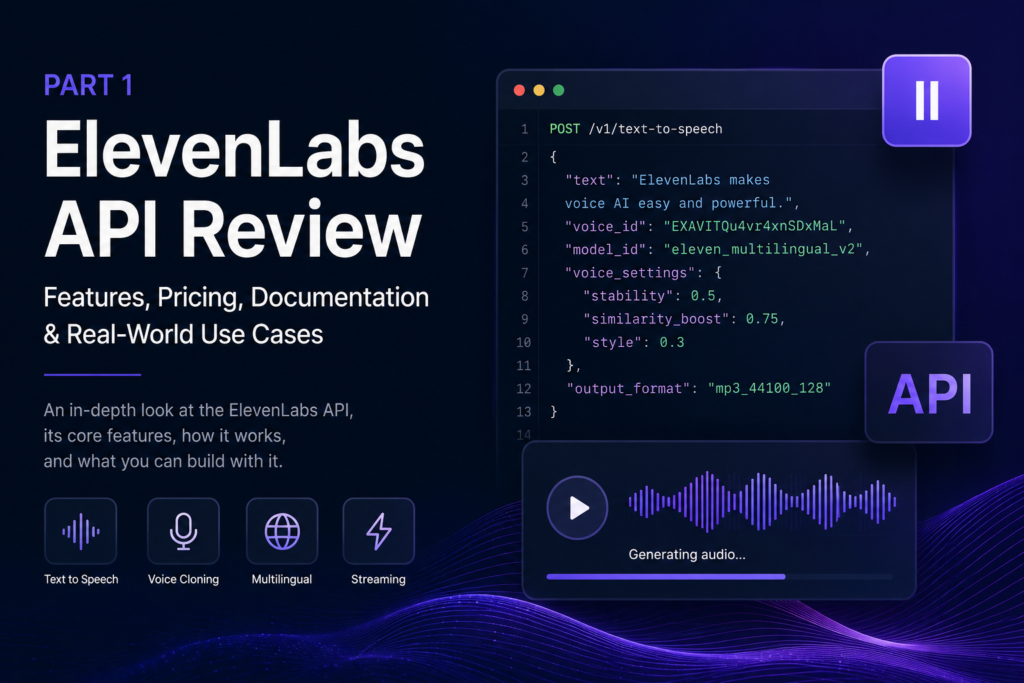
Features, Pricing, Documentation & Real-World Use Cases
Artificial intelligence has changed the way developers build voice applications. Just a few years ago, adding natural-sounding speech to a website, mobile app, or SaaS platform required expensive recording sessions or robotic text-to-speech engines that were easy to recognize.
Today, the situation is very different.
Modern AI voice models can generate speech that sounds remarkably human, complete with natural pacing, emotional inflection, and realistic pauses. Among the growing number of voice AI platforms, ElevenLabs has established itself as one of the industry’s leading solutions.
While many creators know ElevenLabs for its web-based voice generator, the real power of the platform lies in its API.
The ElevenLabs API allows developers to integrate high-quality speech synthesis directly into their own applications, websites, automation workflows, and products. Instead of generating voiceovers manually through the website, you can automate the entire process using simple API requests.
This opens the door to a wide variety of projects, including:
- AI-powered customer support systems
- YouTube automation workflows
- audiobook platforms
- educational applications
- voice assistants
- SaaS products
- accessibility tools
- mobile applications
However, the API is not designed for everyone.
If you’re simply looking to generate an occasional voiceover, the web interface may be all you need. The API becomes valuable when you need automation, scalability, and the ability to integrate AI voices into your own software.
In this review, we’ll take an in-depth look at what the ElevenLabs API offers, how it works, where it excels, where it falls short, and whether it’s the right choice for your next project.
What Is the ElevenLabs API?
Before discussing features and pricing, it’s important to understand what an API actually is.
Many beginners hear the term “API” and assume it’s something only experienced software developers use. While developers are certainly the primary audience, modern APIs have become much more accessible thanks to automation platforms and no-code tools.
An API (Application Programming Interface) is simply a way for two pieces of software to communicate with each other.
Instead of visiting the ElevenLabs website, copying text into a text box, clicking “Generate,” and downloading the audio manually, your application sends that text directly to ElevenLabs through the API.
The server processes the request, generates the speech, and returns an audio file automatically.
This means the entire workflow can happen without any manual interaction.
Imagine you’re building an online course platform.
Every time a new lesson is published, your system could automatically:
- Send the lesson text to ElevenLabs.
- Generate a professional voiceover.
- Save the audio.
- Attach it to the lesson.
- Notify students that audio is available.
No human intervention required.
That is the real value of an API.
How Does the ElevenLabs API Work?
Although the technology behind AI speech synthesis is extremely sophisticated, using the API itself is surprisingly straightforward.
Every interaction follows the same basic process.
- Your application sends a request.
- The request includes your API key for authentication.
- The request contains text and configuration settings.
- ElevenLabs processes the request.
- The platform returns an audio file or streamed audio response.
This entire process usually takes only a few seconds, depending on the length of the text and the selected voice model.
From the developer’s perspective, the API behaves like any modern REST service, making it relatively easy to integrate into existing applications.
What Can You Build with the ElevenLabs API?
One of the biggest advantages of the API is its flexibility.
Rather than solving one specific problem, it provides the building blocks for a wide variety of AI-powered voice applications.
Below are some of the most common use cases.
| Project | Difficulty | Monetization Potential | Recommended |
|---|---|---|---|
| AI YouTube Voiceovers | Easy | ★★★★★ | ✅ |
| Podcast Automation | Easy | ★★★★☆ | ✅ |
| Audiobook Platform | Medium | ★★★★★ | ✅ |
| AI Customer Support | Medium | ★★★★★ | ✅ |
| Language Learning App | Medium | ★★★★☆ | ✅ |
| AI Voice Assistant | Advanced | ★★★★★ | ✅ |
| Accessibility Software | Medium | ★★★★☆ | ✅ |
Notice that these projects vary significantly in complexity. A YouTube automation workflow can often be built with relatively little code, while a conversational AI assistant requires much deeper integration.
The API is flexible enough to support both.
Core Features of the ElevenLabs API
The ElevenLabs API is more than a simple text-to-speech service. Over the last few years, the platform has evolved into a comprehensive voice AI ecosystem with multiple endpoints designed for different use cases.
Understanding these features will help you decide whether the platform matches your project requirements.
Text-to-Speech API
Text-to-speech is the core functionality of the platform and the feature most developers use first.
The API accepts written text and converts it into spoken audio using ElevenLabs’ proprietary AI voice models.
Unlike traditional text-to-speech systems, which often sound flat or robotic, ElevenLabs focuses on natural speech generation. The voices include subtle pauses, breathing patterns, emotional variation, and more realistic intonation.
For applications where the user listens to long-form content—such as audiobooks, educational courses, or YouTube narrations—these improvements make a noticeable difference.
Typical use cases include:
- YouTube voiceovers
- podcasts
- blog-to-audio conversion
- e-learning platforms
- news readers
- accessibility tools
One important thing to understand is that output quality still depends on input quality. Even the most advanced AI voice model cannot compensate for poorly written scripts with long, confusing sentences.
Voice Cloning API
Voice cloning is one of the features that made ElevenLabs particularly well known.
Instead of selecting a voice from the public library, developers can create a custom voice based on audio samples.
Once trained, that voice can be reused automatically through the API, allowing applications to maintain a consistent speaking style across thousands of generated files.
This feature is especially valuable for companies and creators who want to build a recognizable brand voice.
For example, an educational platform could publish hundreds of lessons narrated by the exact same voice without requiring additional recording sessions.
However, voice cloning also introduces important ethical and legal considerations. Developers should only clone voices they own or have explicit permission to use.
Multilingual Speech Generation
One of ElevenLabs’ strongest capabilities is multilingual support.
Rather than creating completely different voices for every language, the platform can preserve much of a speaker’s vocal identity while generating speech in multiple languages.
This is particularly useful for creators and businesses serving international audiences.
Instead of recording separate voiceovers for English, Spanish, German, French, and Japanese, the API can generate localized versions while maintaining a consistent brand voice.
For YouTube creators, this creates entirely new opportunities to expand into global markets without rebuilding production workflows from scratch.
Streaming Audio
For many applications, waiting until an entire audio file is generated isn’t ideal.
Streaming solves this problem.
Instead of generating the complete recording first, the API begins delivering audio almost immediately, allowing users to hear speech while the rest is still being generated.
This capability becomes especially important for:
- AI assistants
- conversational chatbots
- customer support systems
- real-time accessibility tools
- voice-enabled applications
Reducing latency improves the user experience and makes conversations feel much more natural.
Voice Library Access
Another valuable feature is access to ElevenLabs’ extensive voice library.
Rather than creating custom voices for every project, developers can choose from a large collection of professionally designed voices with different:
- accents
- speaking styles
- ages
- genders
- personalities
This allows teams to prototype applications quickly before investing time in custom voice creation.
For many commercial projects, the built-in library is already more than sufficient.
Affiliate Disclosure
Some links in this article are affiliate links. If you purchase a subscription through these links, we may earn a small commission at no additional cost to you.
We only recommend tools that we believe provide real value for developers, creators, and businesses building AI-powered applications.