
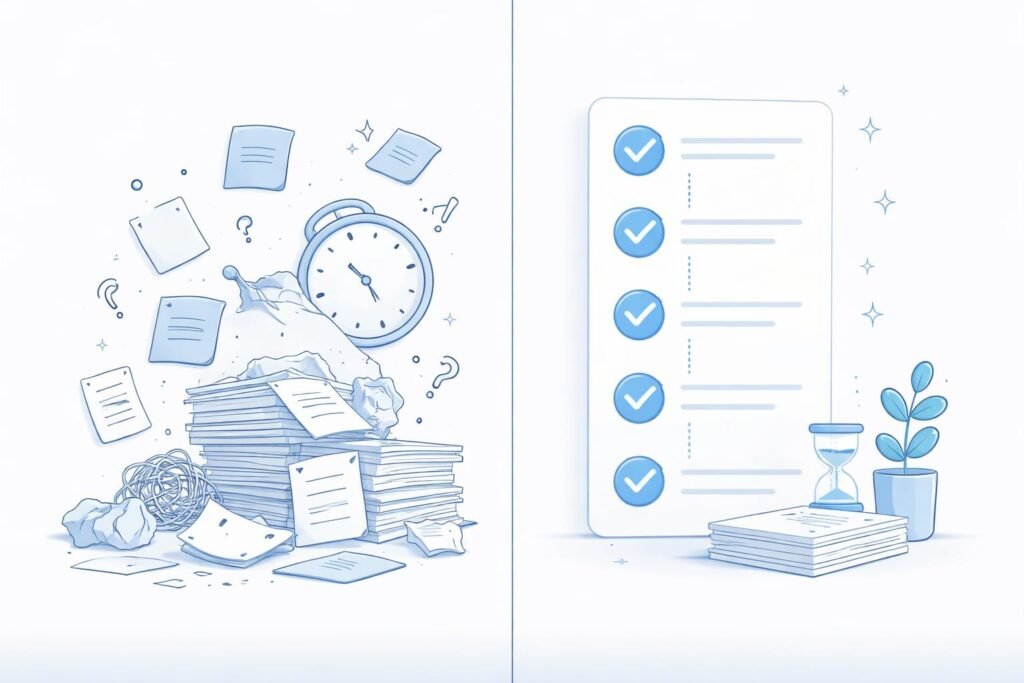
Procrastination is one of the most common problems freelancers face, especially when working without supervision. Unlike traditional jobs, there are no fixed schedules or external pressure, which makes it easy to delay tasks. However, procrastination is not a personality flaw — it is usually the result of unclear structure, overwhelming tasks, or poor workflow design. This guide focuses on practical methods that actually reduce procrastination instead of relying on motivation.
If you are already working online but struggling with consistency, it is also useful to combine this approach with How to Build a Stable Remote Work Routine, where the foundation of structured work is explained.
Why Freelancers Procrastinate
Most freelancers assume procrastination is laziness, but in reality it is caused by:
- unclear tasks
- tasks that feel too large
- lack of deadlines
- constant distractions
👉 When a task is vague or overwhelming, the brain avoids it.
Core Principle: Reduce Friction, Not Force Discipline
Trying to “push yourself harder” rarely works.
Instead of:
❌ “I need more motivation”
Use:
✅ “I need a simpler system”
Step 1. Break Tasks Into Actionable Units
Large tasks create resistance.
Example:
❌ “Write article”
✅ “Write introduction (150 words)”
✅ “Create outline”
Practical structure:
| Task Type | Example |
|---|---|
| Large task | Write blog post |
| Small task | Write 1 section |
| Micro task | Write first paragraph |
👉 Smaller tasks = easier start
Step 2. Use Time Constraints (Not Open Time)
Open-ended work leads to delays.
Instead, define limits:
| Method | Example |
|---|---|
| Time block | 60 minutes work |
| Deadline | Finish by 12:00 |
| Session | 1 focused sprint |
This creates urgency without pressure.
Step 3. Start With the Easiest Entry Point
The hardest part is starting.
Instead of beginning with the most difficult task:
- start with a small, easy action
- build momentum
- continue naturally
👉 Action reduces resistance.
Step 4. Remove Distractions Before Work Starts
Procrastination is often triggered by environment.
Fix before starting:
- turn off notifications
- close unnecessary tabs
- remove phone from workspace
This approach is explained deeper in How to Focus When Working Online, where distraction control becomes a system.
Step 5. Use a Simple Daily Structure
Without structure, procrastination increases.
Basic system:
| Step | Action |
|---|---|
| 1 | Define 2–3 tasks |
| 2 | Start with easiest |
| 3 | Work in time blocks |
| 4 | Review progress |
Step 6. Track Completed Work (Not Just Time)
Tracking time is useful, but tracking results is better.
Instead of:
❌ “worked 5 hours”
Track:
✅ “completed 3 tasks”
This creates visible progress and motivation.
Comparison: Productive vs Procrastination Workflow
| Behavior | Result |
|---|---|
| Vague tasks | Delay |
| No structure | Inconsistency |
| Small tasks | Progress |
| Time blocks | Focus |
Common Mistakes
- waiting for motivation
- trying to do too much at once
- working without clear tasks
- constantly switching between activities
Practical Example
A freelancer who:
- breaks tasks into small steps
- works in 60-minute blocks
- removes distractions
👉 will complete more work in 3–4 hours than someone working all day without structure.
Key Insight
Procrastination is not about discipline — it is about:
👉 reducing task complexity
👉 creating structure
👉 removing friction
Conclusion
Stopping procrastination as a freelancer does not require extreme discipline or complex systems. It requires clarity, structure, and small actionable steps. By breaking tasks down, using time constraints, and controlling your environment, you can significantly reduce resistance and maintain consistent progress. The goal is not to eliminate procrastination completely, but to make starting work easier every day.